

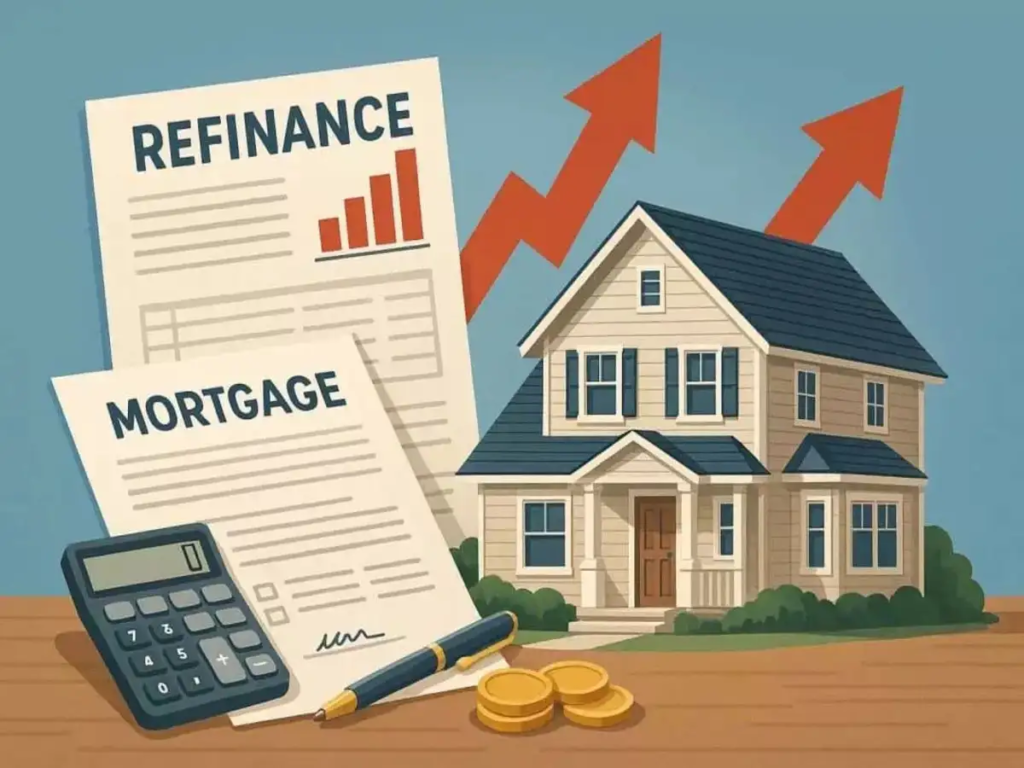
Before refinancing your mortgage, it’s critical to understand the total cost, timing, interest-rate environment, breakeven window, and long-term financial impact. Refinancing can save thousands — or cost thousands — depending on factors like fees, credit score, equity, loan structure, and how long you plan to remain in the home. This guide reveals when refinancing makes mathematical sense, when it doesn’t, and the hidden mistakes that often damage homeowners’ budgets.
Refinancing a mortgage is often marketed as a “smart money strategy,” but many homeowners underestimate how complex — and potentially expensive — refinancing can be. While the idea of obtaining a lower interest rate or unlocking equity sounds attractive, refinancing is not a minor tweak — it is a complete replacement of the existing mortgage with a new one, featuring its own terms, clock, fees, and interest schedule.
According to Freddie Mac research, homeowners saved an average of $2,700 annually by refinancing during favorable rate environments — yet tens of thousands of Americans actually lost money because they refinanced at the wrong time or under unfavorable conditions. This detailed guide explains the reasoning, mathematics, and real-life consequences behind refinancing so you can make a truly informed decision.
What Refinancing Really Means — and Why Many Borrowers Misunderstand It
When you refinance your mortgage, you are not renegotiating your current loan. You are replacing it entirely. The new mortgage comes with:
- Its own start date
- Its own term
- Its own amortization schedule
- New fees and closing costs
- Potential changes in interest exposure
Many banks oversimplify refinancing in marketing language:
“Lower your monthly payment!”
“Take advantage of today’s rates!”
“Unlock cash from your home!”
These promises are emotionally compelling — but financially incomplete.
Refinancing is beneficial only when:
- The interest rate improvement is meaningful
- The breakeven point occurs before you plan to sell
- You are early enough in the loan for interest savings to matter
- The fees do not exceed the long-term savings
- The new mortgage supports broader financial goals
How Refinancing Can Save — or Lose — Money: Real-Life Examples
Example 1: Maria’s Long-Term Loss
Maria refinanced her 30-year mortgage after paying on it for 6 years.
Old interest rate: 5.25%
New interest rate: 4.65%
Monthly savings: $120
She celebrated — until an advisor showed her the real math.
By restarting a full 30-year schedule, she added interest exposure to the entire loan amount again. Over time, that extra interest resulted in $38,000 more paid to the bank, even with her slightly lower monthly payment.
Maria’s logic: “lower payment = good”
Reality: “longer debt = costlier outcome”

Example 2: Jordan’s Refinancing Win
Jordan refinanced from 6.75% to 3.80% during a market dip and used the opportunity intelligently.
Instead of restarting 30 years, he selected:
a 20-year refinance option
Monthly savings: $325
Total interest saved over time: $62,000
He structured refinancing as a strategy — not a reaction.
Example 3: Casey’s Cash-Out Mistake
Casey refinanced to pull $45,000 for a home renovation. The lender pitched:
“Your home value is rising — use the equity!”
The refinance came with:
- A higher interest rate
- A longer repayment timeline
- Increased future interest cost
Total renovation cost: $45,000
Total added long-term interest: $91,000
That kitchen upgrade became the most expensive home remodel imaginable.
How to Calculate Your Refinancing Breakeven Point
Your breakeven point tells you exactly when refinancing becomes profitable.
Formula:
Refinancing costs ÷ monthly savings = breakeven in months
Example:
Total closing/refinancing costs: $6,200
Monthly payment reduction: $220
Result: 28-month breakeven
If you might move or sell within 2 years — refinancing is mathematically a losing deal.
If you’ll stay longer — it may be beneficial.
This stage is where most homeowners fail — they look at monthly payment, not total payments across decades.
The Most Overlooked Refinancing Costs
Refinancing typically costs 2–5% of your loan amount.
Often hidden or minimized are:
- Appraisal fees
- Application fees
- Origination fees
- Title insurance
- Recording fees
- Discount points
- Mortgage broker compensation
- Attorney fees
- Closing costs
- Interest overlap during transition
But the cost most borrowers never see:
Amortization reset
Early mortgage years are interest-heavy.
Late mortgage years are principal-heavy.
Refinancing starts the interest-heavy years all over again.
That’s how lenders profit — and how uninformed homeowners overpay.
Does Refinancing Make Sense in a High-Rate Market?
Surprisingly, sometimes yes.
Refinancing may still be wise if you are:
- Moving from adjustable-rate to fixed
- Removing PMI
- Consolidating high-interest consumer debt
- Changing to a shorter loan term
- Restructuring for retirement budgeting
For example, if you have $25,000 of credit card debt at 18% interest, consolidating it into a 6–7% refinance may be beneficial — but only if you are disciplined and do not re-accumulate debt afterward.
Credit Score & Home Equity: The Pricing Power You Don’t Realize You Have
Even if mortgage advertisements show low rates, your personal financial profile determines your actual offer.
Major factors include:
- Credit score
- Payment history
- Debt-to-income ratio
- Loan-to-value ratio
- Equity percentage
- Employment stability
Borrowers with a 750+ score and 30% equity routinely receive significantly lower rates than those with 650 credit and 5–10% equity.
If you suspect your credit score may improve within 3–12 months — waiting may result in huge savings.
Is Refinancing Worth It for a Small Rate Change?
Many homeowners refinance for just a 0.5% reduction.
That often is not enough.
Refinancing generally becomes beneficial when the rate drop is:
- ≥ 0.75% on a standard mortgage
- ≥ 1.0% for riskier borrowers
- ≥ 0.5% on jumbo loans
- ≥ 1.0% for shorter terms like 15 or 20 years
Anything less may not exceed closing costs — or may result in net loss.
Questions Homeowners Are Asking Right Now About Refinancing
Will refinancing lower my monthly payment?
Often yes — but possibly at the cost of extending debt.
Can refinancing hurt my credit score?
Yes, temporarily due to hard inquiries and new credit activity.
Should I refinance if I plan to sell within a few years?
Only if breakeven occurs first.
Is it better to refinance early or late into a mortgage?
Earlier is typically more beneficial because of interest amortization structure.
Can refinancing remove PMI?
Yes — if your equity exceeds the required threshold.
Practical Takeaways: When Refinancing Makes Sense vs When It Doesn’t
Refinancing is typically smart when:
- You can significantly reduce interest rate
- You move from adjustable to fixed rates
- You shorten loan term
- You remove PMI
- You plan to stay in the home past breakeven
- Your credit score is high and stable
- Fees are competitive and transparent
Refinancing is typically a mistake when:
- You’re already deep into the mortgage
- You restart 30-year terms
- Savings are less than closing costs
- You plan to sell the home soon
- You refinance for emotional reasons
- You’re chasing small interest reductions
- You don’t verify amortization impact
20 Key Principles to Protect Your Financial Outcome
- Only refinance when long-term savings exceed closing costs
- Avoid restarting a new 30-year mortgage if already 5–10 years in
- Check the breakeven timeline before committing
- Compare quotes from multiple lenders
- Examine APR, not just the listed rate
- Watch for origination and lender fees
- Consider 15–20-year refinance options
- Fix your credit score before applying
- Avoid cash-out refinancing unless necessary
- Treat refinancing as a strategic decision, not emotional reaction
- Consider biweekly payments as an alternative to refinancing
- Understand how amortization changes interest structure
- Ask for full disclosure of all fees
- Seek neutral financial advice
- Don’t refinance just because “rates are trending”
- Protect your equity — it boosts financial stability
- Evaluate total lifetime interest payments, not just monthly reduction
- Determine how long you’ll stay in the home
- Understand closing cost impact
- Make sure refinancing aligns with long-term financial goals
Trending Refinancing FAQs
1. What credit score do I need to refinance?
Minimum ~620, but 740+ qualifies for best rates.
2. Does refinancing always save money?
Not necessarily — many homeowners lose money through fees and interest resets.
3. How long does refinancing take?
Typically 25–45 days depending on underwriting speed.
4. Can I refinance with an FHA or VA loan?
Yes — streamline programs may reduce documentation and appraisal requirements.
5. What is a no-closing-cost refinance?
Closing costs are embedded into the interest rate — not eliminated.
6. Can I refinance twice or multiple times?
Yes, but repeated refinancing often increases net cost.
7. Is it better to refinance into a 15-year mortgage?
If you can afford higher payments, yes — interest savings can be substantial.
8. Does refinancing reset my mortgage payoff timeline?
Usually yes — unless switching into a shorter term.
9. Should I refinance during rising interest-rate cycles?
Only under specific strategic conditions — like changing from adjustable to fixed.
10. Should I wait for rates to drop before refinancing?
Trying to time the market is risky — instead evaluate breakeven and personal readiness.
Final Thought: Refinancing Is a Calculation, Not a Trend
Many homeowners approach refinancing with emotion or urgency — but successful refinancing is a disciplined, mathematical decision. Evaluate costs, analyze breakeven timing, consider equity, predict future plans, and view refinancing through the lens of total financial lifespan — not just monthly relief.
Done properly, refinancing can significantly improve financial stability, reduce lifetime interest, accelerate equity growth, and unlock smarter budgeting. Done reactively or ignorantly, it becomes one of the most expensive financial missteps a homeowner can make.